
What is Fuchs’ Dystrophy?
Fuchs’ dystrophy (also known as Fuchs’ corneal endothelial dystrophy and Fuchs endothelial dystrophy) is a disease of the cornea. The cornea is the clear, dome-shaped front portion of the eye that allows light to enter the eye and focus on the retina.
For many patients with Fuchs’ dystrophy, their vision is usually hazy in the morning and clears up throughout the day. Many people with Fuchs’ dystrophy in their 30s and 40s may have Fuchs’ dystrophy but not know it. For most patients, vision problems don’t develop until age 50 or later. Fuchs’ dystrophy tends to affect women more often than men. Having a family history of Fuchs’ dystrophy also increases your risk of developing it.


Glare on sunny days, glare at night time
Vision (even with glasses or contacts) isn’t quite clear. You may have difficulty seeing In broad daylight due to glare and the reflection of light off of buildings and reflective surfaces. Many patients find that while wearing sunglasses may reduce glare, they may have difficulty seeing clearly. Other patients notice a lot of glare at nighttime, especially from car headlights.
Decreased contrast sensitivity
You might have trouble seeing clearly in high-contrast lighting situations (seeing objects in shadows will be difficult). For example, when talking to a person with a bright window behind them, you might have trouble making out the details of their face.

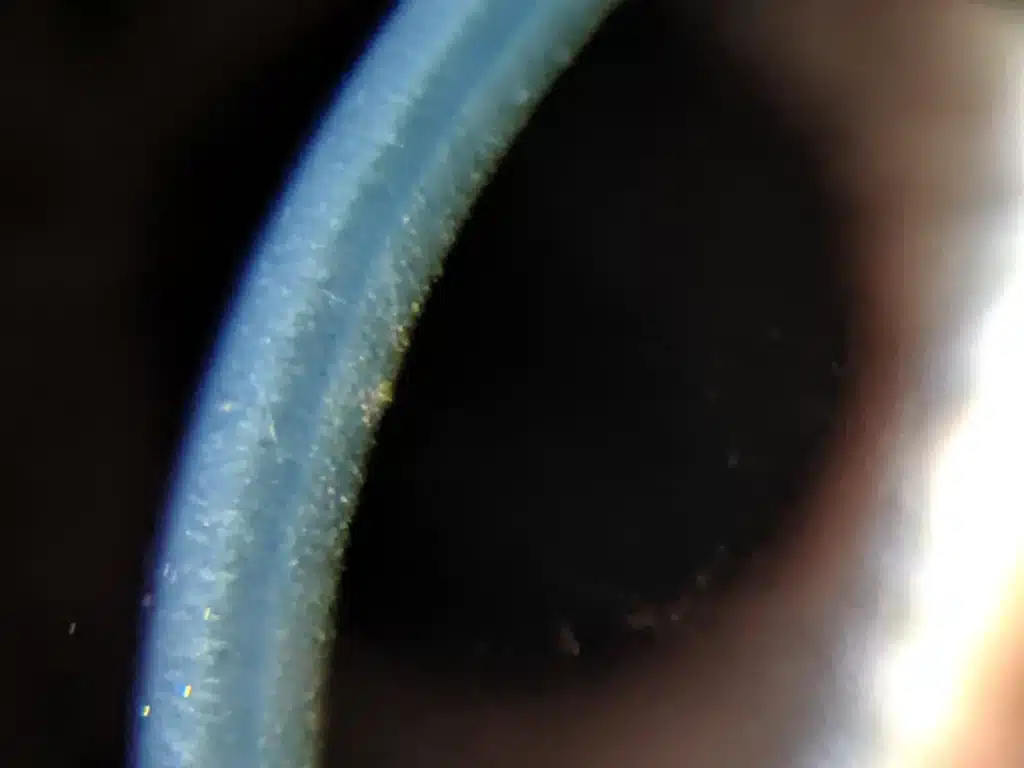
Guttae and swollen cornea
When looking at your eye under the microscope, your ophthalmologist may sometimes note the finding of guttae, or guttata; tiny bead-like clumps of collagen that form on the back of the cornea as a result of stressed or dying endothelial cells.
What causes Fuchs’ Dystrophy?
This condition results when cells in the back-most layer of the cornea, called the endothelium, gradually die off. These cells are responsible for maintaining the balance of water in the cornea, and normally act to pump fluid out of the cornea to prevent it from becoming too swollen, and maintain its clarity. When they die, fluid builds up and the cornea gets swollen and cloudy, and your vision becomes hazy. When looking at your eye under the microscope, your ophthalmologist may sometimes note the finding of guttae, or guttata; tiny bead-like clumps of collagen that form on the back of the cornea as a result of stressed or dying endothelial cells.
Further Reading at the American Academy of Ophthalmology
Is Fuchs’ Dystrophy a genetic disease?
Fuchs’ Endothelial Dystrophy can sometimes be inherited, but not always. Family members can often be affected, sometimes to a mild extent, and sometimes not at all. It is a reasonable recommendation to have your immediate family examined by an ophthalmologist to detect the disease as early as possible, but this is a personal decision.
A number of medical centers in the United States specialize in the genetics of Fuchs’ Dystrophy, including the Johns Hopkins Hospital, University of California San Diego, the University of California Los Angeles, the University of Texas Southwestern, the Mayo Clinic, and others. The genetic cause of the disease is complex —there are many genetic abnormalities thought to be responsible for Fuchs’ dystrophy, including unknown genetic mutations. There are also variations in Fuchs’ dystrophy thought to be related to different genetic causes of the disease. For example, the condition seems to be distinctly different in certain parts of Asia compared to the United States.
How do you treat Fuchs’ Dystrophy?
The “cure” for Fuchs’ dystrophy typically involves an endothelial keratoplasty, a type of corneal transplant. Endothelial keratoplasty is a newer technique for corneal transplant surgery. With Fuchs’ dystrophy resulting from damaged and dysfunctional endothelial cells, endothelial keratoplasty replaces those cells with healthy ones from a donor.
Before endothelial keratoplasty surgery was developed, the older method of treatment involved giving a patient a hypertonic saline solution often known as Muro-128. This was meant to reduce swelling in the eye, temporarily, until the disease continued to deteriorate and the patient needed a full-thickness corneal transplant, called a penetrating keratoplasty. Although waiting for this treatment can restore loss of vision, this results in a longer recovery process, and an overall lower quality of vision.
Ideally, it is better to catch Fuchs’ early so treatment can be done before any scarring and permanent damage to the cornea occurs. Your ophthalmologist can screen for Fuchs’ dystrophy as part of an annual eye health exam.
If I have Fuchs’ Endothelial Dystrophy, when should I get a corneal transplant?
Your ophthalmologist can screen for Fuchs’ dystrophy as part of an annual eye health exam.
Ideally, it is better to diagnose Fuchs’ early so treatment can be done before any scarring and permanent damage to the cornea occurs. There is no ‘hard’ rule as to when it becomes necessary to undergo a corneal transplant. Your ophthalmologist will discuss with you if it is appropriate and medically warranted for you to undergo a corneal transplant.
I have Fuchs’, and I need cataract surgery. What should I do?
For many patients with Fuchs’ dystrophy over the age of 50, they also have at least some degree of a cataract. The cataract can cause the similar symptoms as Fuchs’ — washed out colors, glare, and blurry vision — and it can sometimes be difficult to know for sure whether it is the Fuchs’ or the cataract that is causing vision problems. Most of the time, it is a combination of both.
For many with Fuchs’ Dystrophy, special considerations need to be undertaken when it comes time for cataract surgery. In general, cataract surgery often exacerbates Fuchs’ dystrophy; sometimes to the point where the cornea may not fully recovery from the stress of cataract surgery. Other times, cataract surgery won’t provide adequate improvement in vision because Fuchs’ dystrophy is also impacting quality of vision. For these reasons, many ophthalmologists will recommend undergoing an endothelial keratoplasty surgery (DSAEK or DMEK) at the same time as cataract surgery.
Your ophthalmologist will recommend a treatment plan tailored to your needs based on a thorough evaluation.